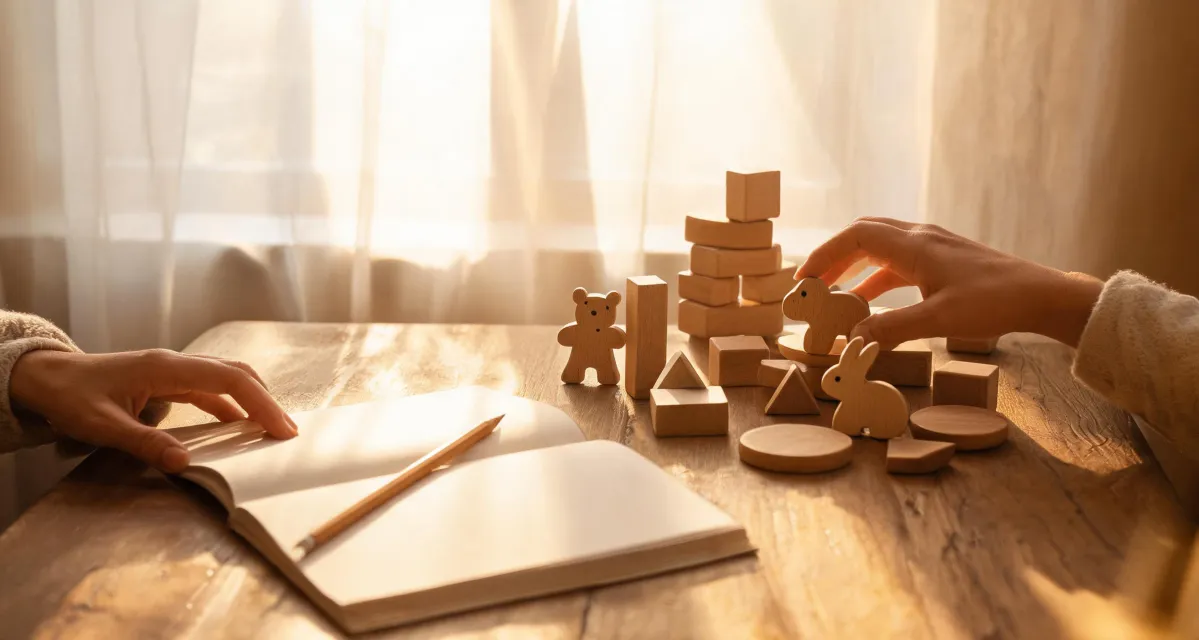
The Saturday morning delivery box is bigger than you expected. Your four-year-old tears into the cardboard while you hover, ready to rescue the smaller pieces. What spills out is a collection of solid wood shapes: a counter frame, a few play-food blanks, a chalkboard menu sign with no words yet printed. No batteries, no speaker, no flashing order buttons. Just the quiet weight of painted wood. Before you can worry about whether that is enough, your child has already stacked two blocks into a burger and is holding it up to your face. 'Welcome to the Star Diner,' she announces. 'Today's special is... whatever you want it to be.' This is the moment a hundred thousand parents meet the same question: is a toy this simple actually going to hold her attention longer than a week? The answer begins with the company that made it. Melissa & Doug was founded in 1988 by Melissa and Doug Bernstein, working out of their basement and Doug's parents' garage, according to the company's own entry on Wikipedia. From day one, the brand has built its reputation on wooden puzzles, art tools, and open-ended educational toys—not on screens and sound effects. That commitment to simple, sturdy materials matters more than you might think: it tells you the people who designed this diner were betting on a child's imagination rather than on a chip. And for a parent standing over a rug covered in wooden pieces, that bet often pays off in quieter, longer, more inventive play.
The diner arrives on your living room floor
You might be staring at the same scene and asking: won't she get bored in an afternoon? It's the most common assumption about wooden toys—that without a soundtrack, a light show, or an animated character, they'll be abandoned after one session. But watch closely. Your daughter isn't waiting for the toy to tell her what to do. She's already making the rules herself. She decides that a square block is a tomato slice, that the yellow circle is a piece of cheese, that the chalkboard menu needs ten items before anyone can order. That act of deciding is the whole point. When a toy comes with fixed scripts—press this button, hear this word—the child follows someone else's story. When it comes with loose pieces, she has to write the story herself. Every meal she invents, every role she assigns, every 'would you like fries with that?' is a sentence she's practicing without realizing it. The question isn't whether she'll be bored; it's whether you can keep up. Because once the diner opens, you are not the parent anymore. You are the customer—and the customer is always ordering.
That founding year isn't just trivia; it's a track record. The company has spent more than three decades refining this exact kind of play. A brand that has weathered toy fads by sticking with wooden, child-led designs is a safer bet than one chasing the latest trend.
The first customer walks in
Let's fast-forward to the third Saturday. The diner is a permanent fixture on the kitchen rug. Your child has stopped asking you what to do with it—she's too busy taking orders. 'What can I get you?' 'You want soup?' 'The soup is hot, so blow on it.' You notice she's not just naming objects anymore; she's building a whole social script. That's not an accident. It's the direct result of a toy that was designed to leave space for a child's mind. Melissa & Doug has built its name on exactly this kind of play—wooden, unscripted, and full of spaces for a child's imagination. Its history is packed with wooden puzzles and art supplies that never perform the play for you. When the toy doesn't produce dialogue, the child has to produce it. And because she's the one producing it, she practices words and rhythms that actually belong to her. This is the mechanism most parents miss: a toy with fewer commands creates more conversation. The practical takeaway? When you hear the same phrase for the tenth time—'Welcome to our diner!'—don't interrupt to correct or suggest. That repetition is a child building fluency, one order at a time.
The deeper reason this works has to do with the difference between exposure and ownership. Electronic toys often say a word and ask a child to repeat it. That's exposure. But the dinner table is a place of ownership. When your child says, 'Tonight we have grilled cheese with a side of giggles,' she has not just heard a phrase—she has made a phrase. She has assembled words like the wooden blocks in front of her, and in doing so she owns them. Linguists and speech therapists call this kind of play 'contextualized language practice.' It's why the same child who struggles to recall vocabulary from a flashcard app will confidently rattle off a full restaurant dialogue, complete with a complaint about the imaginary burnt toast. The roles matter too. Taking on the diner-owner role lets her practice politeness and authority in a safe space. As a customer, you get to model question forms ('Do you have anything without pickles?') that she'll absorb. The key is to stay in character and let her lead. If she wants the same order every single time, let it be the same order. That sameness is part of the ritual, and the ritual is the learning.
Setting the first table: your three-step play routine
Your first instinct might be to hand her the diner set and see what happens. That works, but it leaves a lot of play on the table. After dozens of times encouraging this kind of play, a simple three-step routine gets the grill fired up faster. Step one: set the stage without script. Unpack the pieces together, name each one casually ('Here's the chalkboard.' 'That's the bell.'), then step back. Don't suggest a plot. Let the child's first action become the story line. Step two: take the customer role. Once she's arranged something that looks like a counter, sit down, make eye contact, and ask a serious question: 'Excuse me, what's today's special?' When she answers—'macaroni and clouds'—accept it without correcting. Write it down if there's a menu board. Your job is to be a believable, slightly hungry customer, not a teacher. Step three: stay until you're asked to leave. Dramatic play builds momentum in waves; the first wave might be two minutes long. If you walk away after the first order, she may close up shop. But if you stay for 'dessert,' then 'coffee,' then 'the check,' you're giving the scene time to deepen into the language-rich territory where the real practice happens.
Here's how that routine played out on one rainy Tuesday. The counter was a low table, the grill was a pair of upturned blocks, and the 'special' was a slice of felt grapefruit that had never been cut. 'I'll take the grapefruit special,' you say, 'but can I have it without seeds?' Your child stares for a second, then grabs the felt fruit and carefully picks at imaginary seeds. 'No seeds today,' she says. 'But it's very juicy. Be careful.' In that exchange, she's doing several things at once: she's negotiating a modification, projecting a future hazard ('be careful'), and reading her customer's mood. No toy manual could prescribe those lines. The routine works because the adult stays deliberately under-competent. You ask for things that are slightly awkward: 'Do you have a high chair for my imaginary giraffe?' You misremember the menu. You leave a fake tip of two blocks. Every mistake you make becomes a repair opportunity for her. When she straightens you out, she's practicing the language of explanation and persuasion. That's why step three says stay until you're asked to leave—the longest scenes come when the customer keeps making the waiter's world a little more complicated.
Where the Star Diner beats the tablet — and where it doesn't
Now for the comparison every parent makes: why not just get the singing, flashing kitchen that talks back? Let's be honest—electronic toys are dazzling at unboxing. A plastic stove with a hundred sounds can entertain for an entire afternoon. But think about who is doing the entertaining. The toy performs, and the child watches. The Star Diner, by contrast, is a stage without a script. On the first weekend, a child might spend twenty minutes setting up and another five actually playing. That initial stretch can feel like a failure to an adult used to instant engagement. But the second weekend, the setup shrinks and the play expands. By the fourth weekend, the diner has become a recurring universe with its own mythology, recurring customers (you), and a menu that changes based on her whims. That's durability. And here's a practical detail that makes the decision easier: ordering the set is low-risk because Melissa & Doug's official store offers free standard shipping on orders over $49, and only very large, heavy pieces trigger an extra $15 oversize fee. That policy means the purchase feels less like a gamble and more like an easy bet on a brand that's been making wooden toys since 1988. Knowing the shipping terms won't make the play richer, but it does remove one more reason to hesitate.
To be fair, the Star Diner isn't a universal replacement for every kind of screen time. There will be days when your child just wants to be swept away by a story, and a good video app can do that beautifully. Electronic toys also shine when a child is too tired to invent—sometimes passive play is genuinely restorative. The point isn't that wooden toys are always better; it's that they're better for a specific kind of growth. When your goal is language, social turn-taking, and flexible thinking, a low-structure set gives you more chances per minute than a high-tech one. The child who runs the diner is talking, listening, negotiating, and planning. Those are the exact skills that make a child feel confident in a classroom and a playground. And the beauty of it is that you don't need to add anything to make it happen. No extra apps, no replacement parts, no batteries. The open-ended format is the feature. The absence of instructions is the instruction.
The diner opens again
On a Sunday evening, weeks after that first cardboard box landed on your rug, the diner is still open. The chalkboard menu now has a hand-drawn special that changes daily—tonight it says 'moon soup with T-rex sprinkle.' Your child no longer needs you to suggest an order. She greets you, hands you a laminated menu (a paper plate wrapped in tape), and waits with the patience of a seasoned server. The room is quiet except for your pretend chewing. No beeps, no songs, no progress notifications. Just the sound of a four-year-old narrating 'the soup is boiling over' and 'Sir, your giraffe is asking for the window table.' This is the moment parents usually realize what the toy was doing all along: it wasn't the plaything; it was the setting. The characters, the plot, and the dialogue all came from her. And they will come again tomorrow, because the set will be there, ready and unchanged, waiting for the next story she decides to write.
The next time you walk past the toy aisle, the flashy electronic set might still catch your eye. But you'll know that the real value isn't in the batteries or the screen. It's in the voice of a four-year-old saying, 'What can I get you today?'
So was it worth it? The answer is in what you don't see: the sentences she now says without thinking, the confidence she has when she's the one in charge, the way she can turn a stray block into a gourmet meal. That's the real return on a wooden restaurant set. Unlike a toy that entertains by itself and then collects dust, this one gives a child the keys to the game. She invents the menus, assigns the roles, and writes the dialogue—and in doing so, she builds the language skills that no app can hand her. It's more durable than the electronic alternative both in shelf life and in play value, because an open-ended toy never runs out of updates. The next time you hear 'Welcome to our diner,' lace up your imaginary shoes and sit down. Order something ridiculous. Listen to what she says. That's the whole curriculum, served fresh on a wooden counter.